Clans
Factions in SHOGUN 2
The original SHOGUN 2 grand campaign is documented with nine major clans, plus three clan packs: Hattori, Ikko-ikki, and Otomo. Complete Edition keeps that campaign and, on Steam and in SEGA’s announcement, adds more than 50 newly playable minor factions. A full official name list of those new factions was not on the store page or the FAQ.
On this page
Nine major clans
Wikipedia’s clan-by-clan account and the Total War Wiki’s playable list agree on nine grand-campaign clans before the packs. Strengths below are the published clan identities, not a ranking.
Chosokabe
Based in Tosa. Described as fielding stronger archers and drawing more income from farms.
Date
Based in Iwate. Described as fielding stronger no-dachi samurai, with a charge bonus for units.
Hojo
Based in Izu and Sagami. Described as castle builders and siege specialists.
Mori
Based in Aki. Described as a naval clan.
Oda
Based in Owari. Described as fielding superior ashigaru.
Shimazu
Based in Satsuma. Described as fielding stronger katana samurai, with more loyal generals.
Takeda
Based in Kai. Described as fielding superior cavalry.
Tokugawa
Starts in Mikawa as a vassal of Imagawa. Described around diplomacy, ninja, and metsuke.
Uesugi
Based in Echigo. Described around Buddhism: stronger monks and warrior monks, plus trade income.
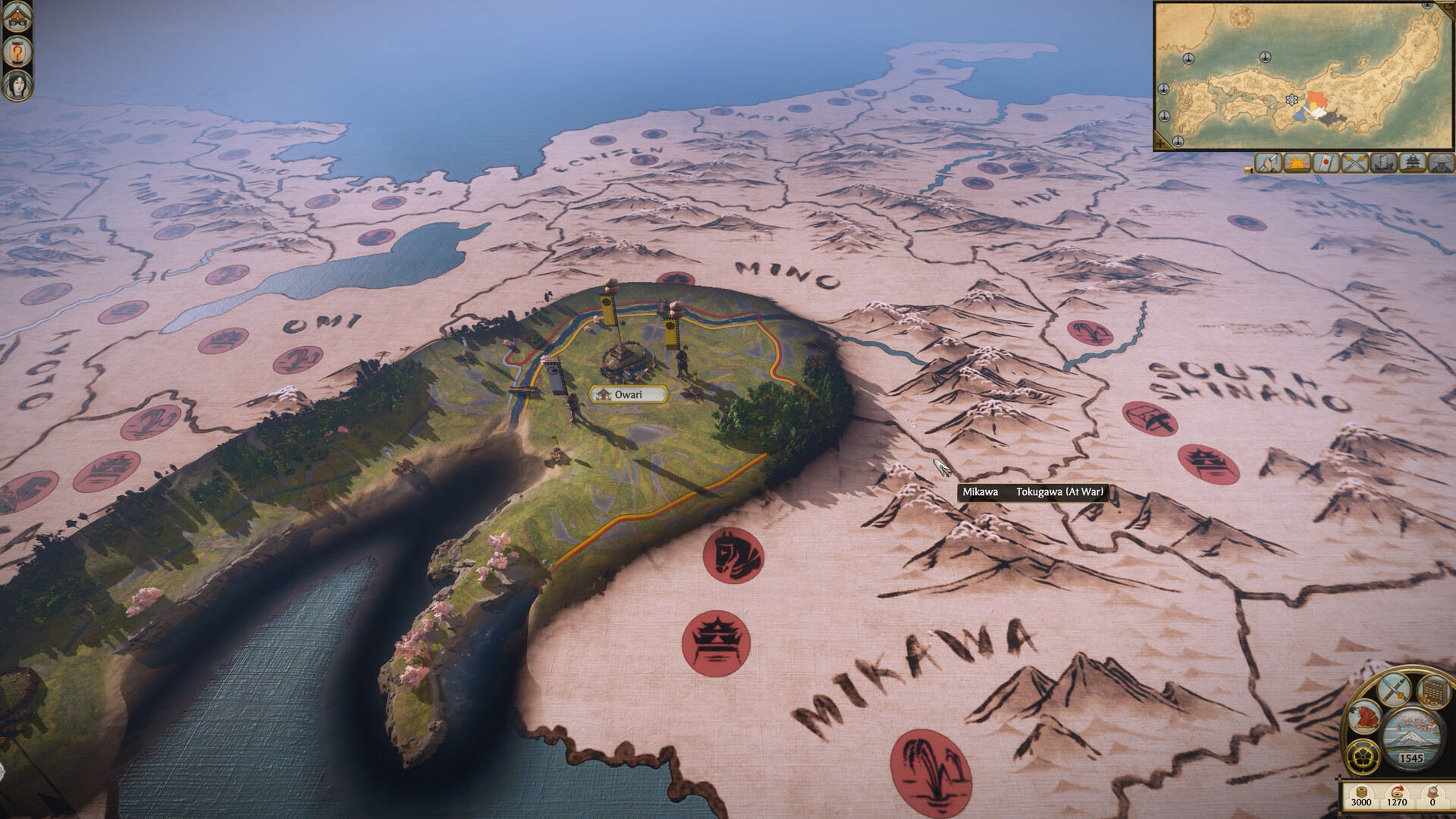
The map in that screenshot is a campaign already in motion, not a labeled turn-one start. Owari is the Oda home province in the written clan list. Mikawa is the Tokugawa home province. Neighboring names visible on the map include Omi, Mino, and South Shinano.
Hattori, Ikko-ikki, and Otomo
Three further clans were downloadable content. Wikipedia notes that Hattori began as a limited-edition and pre-order clan before the Hattori Clan Pack sold the same unlocks.
- Hattori, in Iga, recruit specialist ninja. The pack also includes the 1575 Battle of Nagashino scenario.
- Ikko-ikki hold Echizen and Kaga. They are described as a league of religious rebels who recruit ronin and stronger warrior monks. The pack adds a separate technology tree and the 1574 Battle of Nagashima.
- Otomo hold Bungo and Buzen, start Catholic, and recruit stronger firearm units, including Portuguese terços.
The Total War Wiki lists all twelve names as playable factions on the grand campaign once those packs are present. Complete Edition’s FAQ says the associated DLC is in the package, with the Blood Pack called out as the exception, so these three clans sit inside that claim.
The new minor factions
Steam, SEGA, and Creative Assembly all say the edition adds more than 50 newly playable minor factions. They do not publish the roster on the pages used for this guide. Counting “50+” as a headcount of every crest would be a guess.
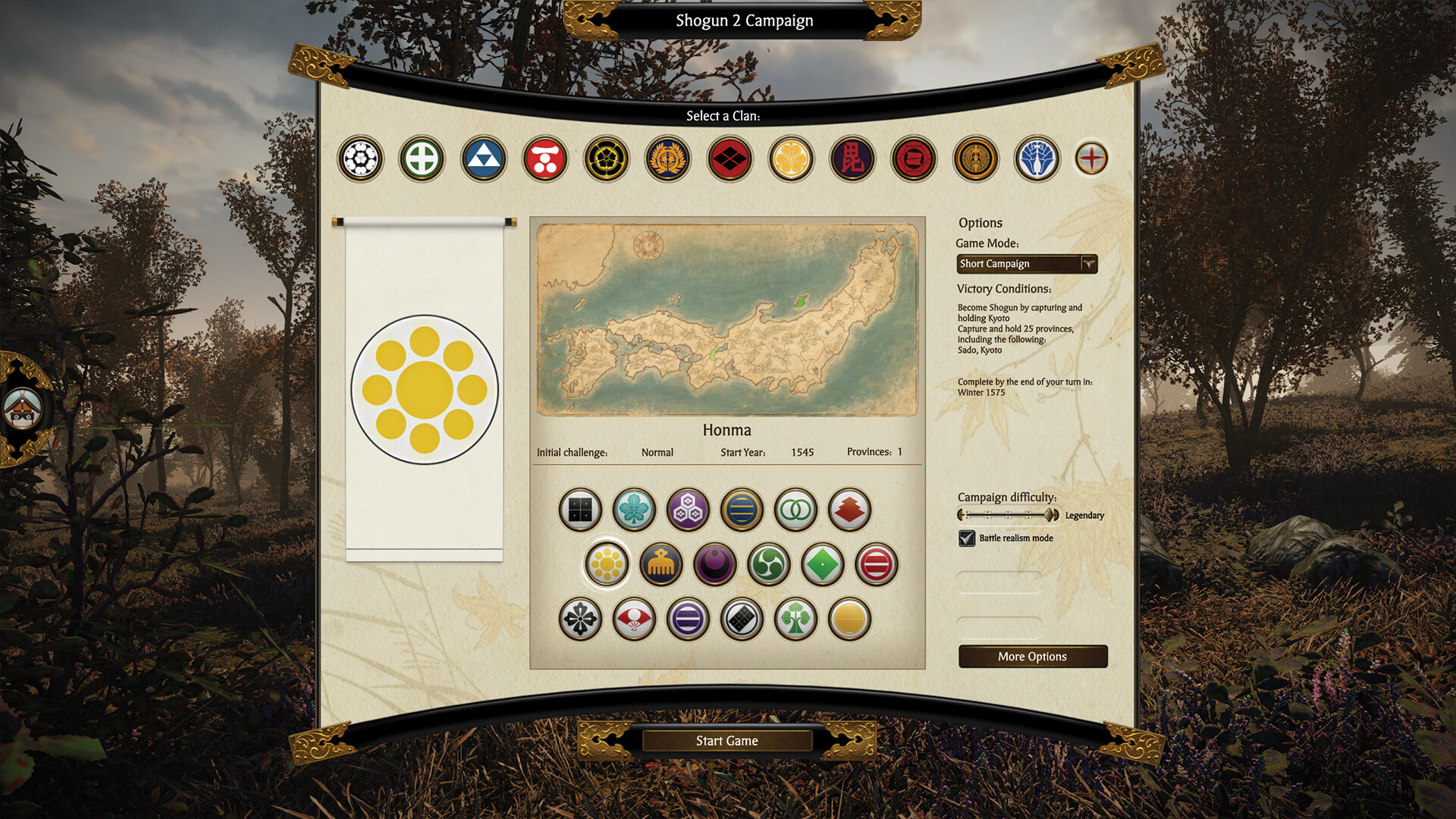
One name is readable in the store’s clan-select screenshot. Honma is selected. The card shows one province, initial challenge Normal, and start year 1545. The short-campaign victory text on that card says the player becomes shogun by capturing and holding Kyoto, must hold 25 provinces including Sado and Kyoto, and must finish by the end of the turn in winter 1575. The difficulty control in the shot is set to Legendary, and a battle-realism option is present. Those victory lines are what the Honma card displays. This page does not treat them as a checked list for every other clan.
The Total War Wiki’s pre-Complete-Edition index places Honma among grand-campaign clans that were not player-selectable. Seeing Honma on the new select screen matches the “newly playable minor factions” claim. The other crests in the screenshot are not transcribed here, because the image does not print their names in a list this guide can quote without error.
Not listed in the sources read for this page: a complete, official spelling list of the new minor factions, their home provinces, or any statement that their bonuses match a particular mod or wiki table.
Rise of the Samurai and Fall of the Samurai
These rosters belong to the other two campaigns, which are separate starts. The three campaigns page covers the history. Names below are the playable lists on the Total War Wiki.
Rise of the Samurai
Six playable clans: Hiraizumi Fujiwara, Kubota Fujiwara, Kamakura Minamoto, Kiso Minamoto, Fukuhara Taira, and Yashima Taira. The same index lists a long set of non-playable clans for that campaign. This guide does not assume Complete Edition flipped all of them to playable. SEGA’s “more than 50” line is not broken down by campaign.
Fall of the Samurai
Ten playable domains once DLC clans are included, five Shogunate and five Imperial. Wikipedia describes their emphasis as follows.
- Aizu, Fukushima: traditional units and cheaper castle construction.
- Nagaoka, Echigo: modern units and commercial income.
- Jozai, Kazusa: guerrilla fighting and faster movement in battle.
- Obama, Wakasa: higher tax income and lower upkeep for land units.
- Sendai, Miyagi: diplomacy and milder public-order penalties.
- Satsuma, starting with Satsuma and Osumi: stronger administration.
- Choshu, Nagato: modern military development and combat bonuses.
- Tosa: naval strength and bombardment range.
- Saga, Nagasaki: Western trade and artillery.
- Tsu, Iga: ninja agents and province conversion.
Wikipedia says every Shogunate faction in that expansion can recruit Shogitai and the Shinsengumi police force. It does not say Complete Edition rewrote those bonuses. The FAQ does not discuss faction balance.
Campaign rules that apply once a clan is chosen — research, religion, agents, and Realm Divide — are collected on the campaign guide.